Nature Photographer: Underwater Photography of Crested Kingfishers and Common Kingfishers... Regarding Feeding (Part 1) / Shigeki Iimura

Underwater predation photography of Crested Kingfishers and Common Kingfishers
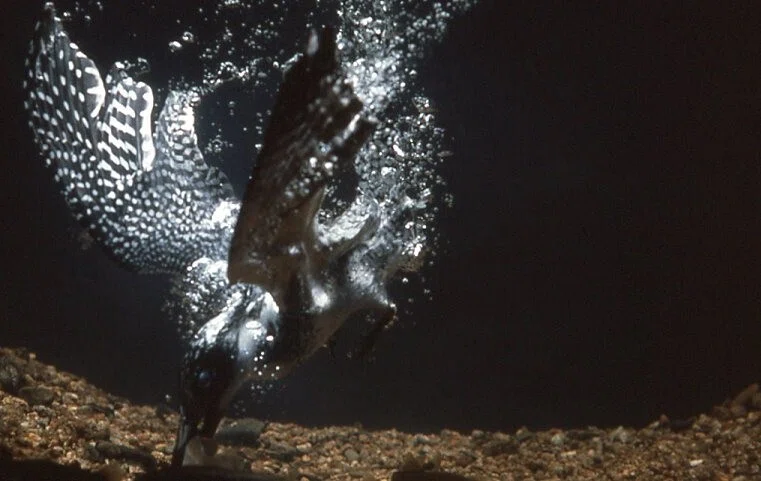
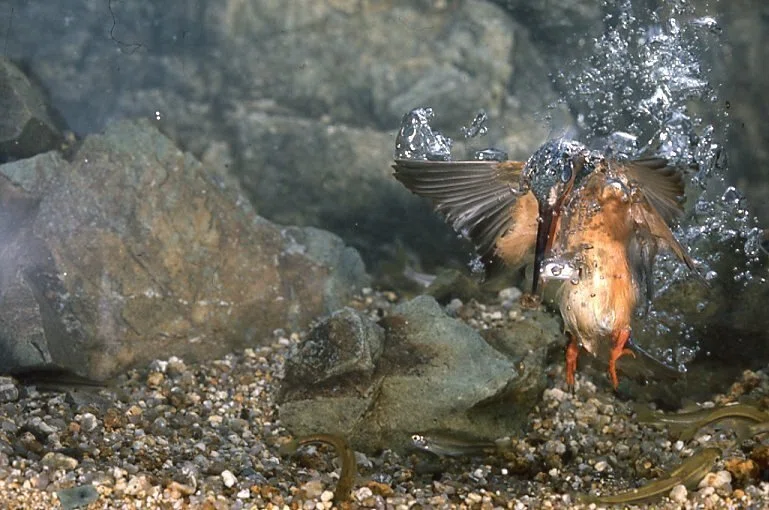
The two photos above were taken by me in my late twenties using a film camera.
When I decided to photograph underwater predation, I thought there were two possible methods. One is to submerge a camera in the water, and the other is to have the birds dive into a water tank.
I chose the water tank method because I wanted to see the moment they catch fish underwater with my own eyes.
So, I thought about how to get them to dive into a water tank.
First, I created a pond in the shallows where the birds usually feed.
I collected fish from that river and put them in there.
If I placed a perch near the pond so that the fish in the pond were easy to see,
eventually, the birds would notice the pond and start catching fish from it.
Once the birds were completely used to the pond and were catching fish from it without any wariness, I filled in the pond and placed a water tank there.
Days of catching and fishing for bait
I wrote that I put fish in the pond, but a large quantity of fish is needed. Common Kingfishers come to the feeding site about every 50 minutes and eat three to four pale chubs.
Crested Kingfishers only come to the feeding site mainly in the early morning and near dusk, but they need five to six fairly large pale chubs per day.
If I shot in the morning, the afternoon was spent entirely on catching and fishing for bait.
Pale chubs will die without fresh, flowing water. So, I used a plastic kerosene tank, made many holes in it with a soldering iron, and used it as a large fish basket.
I would put the collected pale chubs in that basket and submerge it in the river. By doing this, the pale chubs would not die, and I repeated the process of releasing fish from that basket into the pond early in the morning.
Building the water tank
I photographed the Common Kingfisher underwater using a commercially available 60cm tank, but the problem was the tank for photographing the Crested Kingfisher.
I decided that I had no choice but to build a tank large enough for the large-bodied Crested Kingfisher to dive into, so I bought plywood and acrylic at a home improvement store and used glue and silicone rubber to create a tank about half the size of a tatami mat.
Although I built it, I had concerns and anxieties about transporting the tank from my home to the river and whether it could withstand the water pressure when I actually filled it with water at the river, but I managed to take the photos.
On baiting
Baiting was necessary for underwater photography. Baiting is considered a taboo, and even on television programs that deal with wild animals, they do not openly announce that they "used bait to film" or "created a stage," but it is difficult to film everything in its natural state, and one is forced to use a "miniature garden-like setup" or a "water tank" where the subject is easier to photograph.
Photographing ecology in detail means that if you don't make nature "unnatural" somewhere, you cannot show the core parts, and it becomes a battle with a dilemma.

